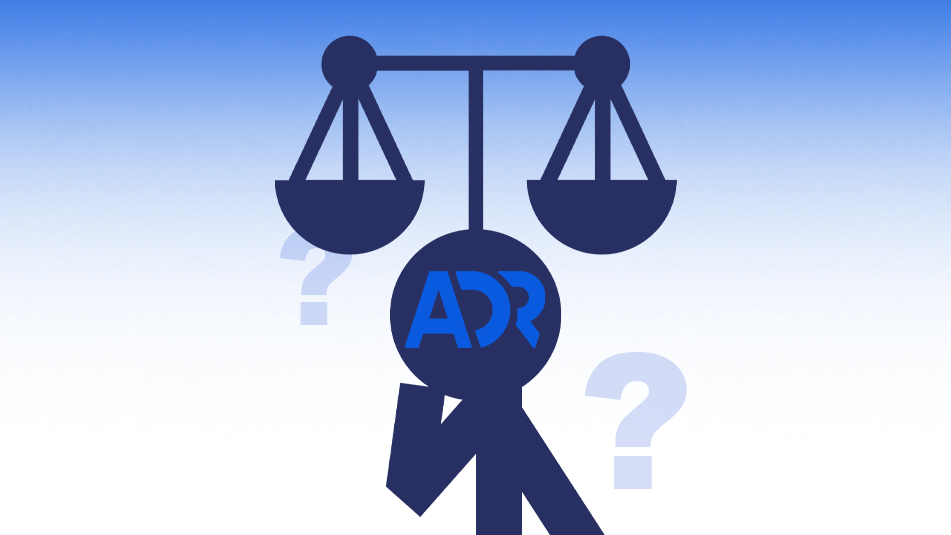






If you’ve ever had to complain to a business, you’ve probably had a scary thought in the back of your mind: … What if I have to take them to court?
Luckily, if you’ve stumbled across this article via our website dedicated to all things Alternative Dispute Resolution (ADR), you’re probably aware that court isn’t your only option in that situation:
ADR, though less commonly talked about, can be just as effective, accessible, and legally binding as taking your complaint to the courts – and it’s often free!

However, before we even get into comparisons, it’s important to underline the following (forget everything you read in the blog title!):
There is no such thing as ‘better’ or ‘worse’ when it comes to methods of resolving your complaint: only what is more suitable for your case.
Both court and ADR have an important role in resolving disputes – and are 2 of the most common methods people choose to do so – but they do differ in terms of cost, speed, procedure, and the types of disputes they are best suited to handle.
The goal of this article isn’t to deter you from using either court or ADR… Instead, we want to give you the facts, and lay the differences out clearly so that you can make an informed decision about the most appropriate option for where to take your complaint.
There is no right or wrong answer here!
So… What is Alternative Dispute Resolution (ADR)?
In the legal context, ADR stands for Alternative Dispute Resolution. But since that’s a bit of a word-salad, you can think of it as A Different Route;
Essentially, ADR is a quick (often FREE) alternative to taking a trader you’re in dispute with to court. A neutral third party (such as CDRL) steps in to regulate the process and ensure fairness to both sides.
ADR is widely used in consumer disputes because it can offer flexible ways to resolve disagreements while allowing the parties greater control over the process, and it’s often seen as the pre-court option.
AKA: Even though ADR outcomes can be legally binding, using ADR doesn’t necessarily rule out the option of using court later. ADR can just be utilised as an attempt to resolve things amicably!
If you want to find out more about the specifics of ADR, and what types of ADR are available, please see our dedicated article on the topic: What is Alternative Dispute Resolution (ADR)?
 What does going to Court involve?
Most of us have a pretty clear image of what a court looks like in our heads: judges, lawyers, a gavel (although in reality this is a myth as judges in the English courts have actually never had a gavel)… But what does it all mean for a consumer looking to resolve their complaint?
Court proceedings involve presenting a dispute before a judge (or other judicial decision-maker), who considers the evidence and applies the relevant law before reaching a legally binding decision. The process may involve written submissions, hearings, witness evidence, and, in some cases, legal representation.
They’re often seen as a last-ditch resort, as the process of actually taking a trader to court can be expensive and lengthy – however, the decision reached in a court is final (unless you appeal the decision), so it is effective.
Court proceedings remain an essential part of the justice system, particularly for disputes involving complex legal issues, or where judicial enforcement is required. There is no other body with more power to resolve disputes than the courts!
 ADR vs Court: A Comparison
 Cost
Cost
As aforementioned: for many consumer disputes, ADR is often less expensive than court proceedings.
Court cases may involve filing fees, legal representation, expert evidence, and other litigation-related costs. The overall expense depends on the amount you’re claiming, the complexity of the dispute and whether lawyers are involved.

For example, at CDRL, our following 4 Adjudication ADR schemes are completely FREE to use:
- AviationADR (for air-travel complaints)
- RetailADR (for retail complaints)
- CommsADR (for non-regulated communications provider complaints)
- UtilitiesADR (for non-regulated utility complaints)
However, since Consumer Arbitration is an Arbitration scheme – not Adjudication -, that particular scheme charges consumers a small upfront administration fee:
- £10 for claims up to £750
- £25 for claims over £750
Now, let’s compare the above with the current fees associated with bringing a claim to a UK court:
| AMOUNT YOU’RE CLAIMING | COURT FEE |
| Up to £300 | £35 |
| £300.01 – £500 | £50 |
| £500.01 – £1000 | £70 |
… And the fees to take your complaint to Court keep climbing beyond these figures, depending on the amount you’re claiming. Check the UK Government’s official website for up-to-date information.
Just using this comparison alone, you can see that even the paid ADR scheme (in this case, Consumer Arbitration) is far cheaper to use than going to court; even our fee for the highest value claims bracket (£25) is below the minimum you’d pay to claim back far less in the courtroom (£35), and the outcomes are just as legally binding!
So, purely from a pricing perspective, (bearing in mind that all of our other ADR schemes are completely free to use), it’s clear that ADR is generally the cheaper option.
That’s not to say that all ADR schemes are cheap, though – you should always do your research on the specific scheme and provider you’re using!

Legitimacy and Regulation
A lot of people tend to assume that court is the only legitimate, truly effective method of resolving a dispute, just because it’s associated with the government.
While it’s absolutely true that court is legitimate, and heavily regulated, that doesn’t mean it’s the only legitimate, regulated option to resolve a dispute – and it’s certainly not the only option whose legally binding outcomes get taken seriously!
ADR schemes can be just as regulated, legitimate – and can provide legally binding outcomes that are enforceable in court, too!
For example, CDRL is an ADR provider approved under the Alternative Dispute Resolution for Consumer Disputes (Competent Authorities and Information) Regulations 2015/The Digital Markets, Competition and Consumers Act 2024, by the Civil Aviation Authority, Chartered Trading Standards Institute and Ofcom.
… Did you catch that? We’re approved by 3 major regulatory bodies:
The CAA is a government agency. The CTSI operates under a Royal Charter. Ofcom is government-approved regulatory body.
We point this out not to pat ourselves on the back… But to demonstrate to you that ADR can be just as subject to legal and regulatory oversight as the courtroom!
Using CDRL as an example, we operate according to strict deadlines, rules, and our services are annually reviewed to ensure we maintain our high standards.
Check out our Annual Activity Reports here: Annual Activity Reports
 Speed
Speed
ADR can often resolve disputes more quickly than court proceedings.
Again, every ADR scheme and ADR provider will differ in their process and timeframes, so it’s important you do your research.
However, using ourselves here at CDRL as an example, our 4 free Adjudication schemes will reach an outcome on your case within 60 Days of us declaring a Complete Complaint File! For our Consumer Arbitration scheme, this is only 30 Days.
Don’t believe us? You can see stats on our Average Turnaround Times across each scheme’s homepage!
For example, take a look at AviationADR’s stats here!
By comparison, court proceedings can often take a lot longer due to all the procedural steps, scheduling requirements, and backlog of cases. This can mean that, particularly where your dispute is contested or legally complex, you could be looking at a timeframe of anywhere between 4 – 12 Months to reach a resolution.
That said, these are just rough estimates. Unlike ADR, courts do not have strict deadlines set out that have to be followed when it comes to reviewing your dispute, as each case can greatly differ. Some court procedures – such as small claims processes – may provide relatively straightforward and timely resolution for suitable cases.
Outcomes
One important difference between ADR and court is the nature of the outcome of each process.
As we’ve stated previously, ADR can absolutely produce legally binding outcomes (depending on the scheme and type of ADR being used), just like a court outcome. However, there can be caveats to this.
For example, at CDRL, if you use any of our 4 free Adjudication schemes, the outcome is only legally binding if you choose to accept it within 14 days of us issuing it.
By contrast, the outcomes of our singular Arbitration scheme – Consumer Arbitration – are immediately legally binding under the Arbitration Act 1996.
However, as always, we are only 1 ADR provider amongst many. You always need to check the rules of the specific scheme and provider you’re using in order to find out whether their decision on your case will be legally binding or not.
Court judgements are (as you probably already guessed) legally binding and enforceable through the legal system.
If an ADR scheme’s decision is legally binding, it is just as legally binding as one issued by a judge – both can be enforced in the courtroom afterwards.
 When might ADR be suitable?
ADR may be suitable where:
- Both parties are willing to participate in resolving the dispute
(Most ADR schemes have a list of Participating Members – traders who have agreed to partake in their scheme & be bound by their decisions!) - The dispute concerns everyday consumer issues such as goods or services
- A quicker or less formal process is preferred
- A mutually agreed solution is possible
When might Court be suitable?
Court proceedings may be the better option where:
- A legal ruling is needed to determine the parties’ rights
- One party refuses to engage in ADR
- The dispute involves complex legal or factual issues
- Enforcement of a decision is likely to be necessary
- ADR has been attempted without resolving the dispute
Which Process is right for me?
There is no universal answer to whether ADR or court proceedings are “better.” The most appropriate process depends on the circumstances of each dispute, including its complexity, value, the willingness of the parties to cooperate, and the outcome being sought.
In many cases, consumers may choose to explore ADR first because it can provide an opportunity to resolve the dispute cheaply, efficiently, and with minimal stress. If ADR does not result in a resolution, court proceedings may remain available where appropriate.
Rather than viewing ADR and the courts as competing systems, they can be seen as complementary mechanisms working together within the broader justice framework. The most suitable option will depend on the particular facts of the dispute and the needs of the parties involved.
How do I get started with ADR?
If your complaint is within the aviation, retail, non-regulated utility or communications sectors, you can start the process with us today via any of our relevant schemes below:
> CommsADR
Make sure to read through our sites carefully to understand the process, the requirements, and next steps. If your complaint isn’t eligible to be escalated with us, remember: there are many other ADR providers out there who may be able to help you too!

Want to learn more about Alternative Dispute Resolution? Follow our social media platforms below!